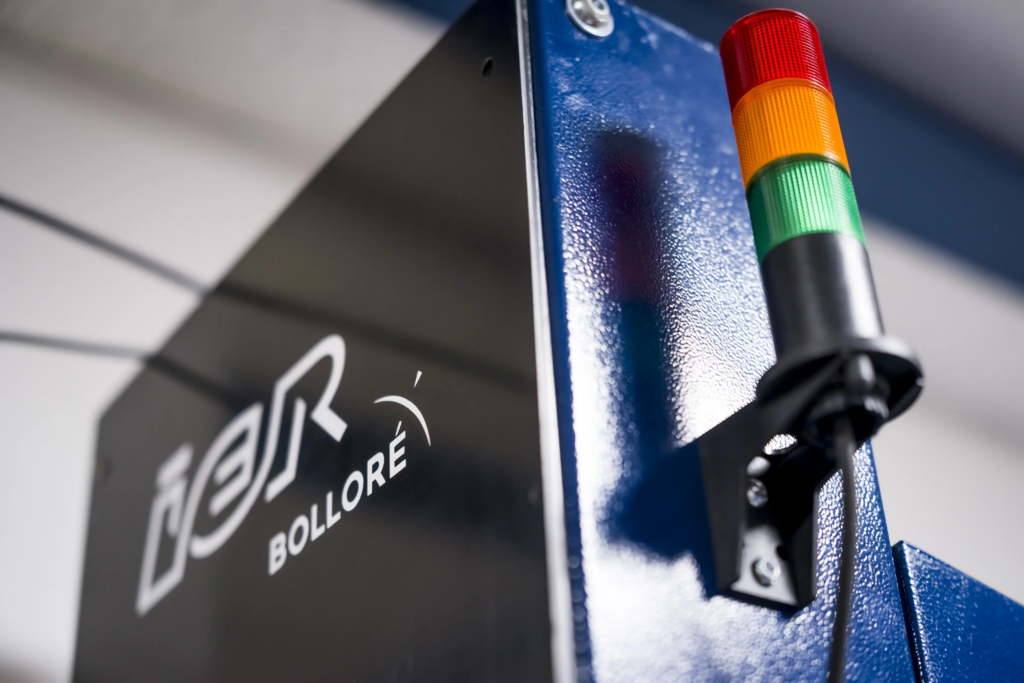
As identification and tracking requirements continue to intensify, traceability has become a key factor in operational performance for logistics players. Barcodes, QR codes, mesh networks: among these technologies, RFID (Radio Frequency Identification) and BLE (Bluetooth Low Energy) stand out as two particularly powerful solutions—yet they address very different needs.
RFID is a traceability technology [LL1.1] that uses radio signals to identify and track objects or people without direct contact. RFID tags or labels are attached to the items or containers to be tracked and are then read by various types of reading equipment.
These include RFID gates or portals, reading tunnels and chambers, forklift-mounted kits, as well as compatible mobile terminals.
What is a BLE ?
BLE is a wireless identification technology based on Bluetooth. Like RFID, it does not require direct contact. Beacons are placed within a warehouse or directly on the objects to be tracked and communicate with gateways.
One of BLE’s advantages is that it does not require dedicated reading equipment, as any device with Bluetooth capability can detect the beacons. This technology is particularly suited for tracking individual items, as each item must be equipped with its own beacon. As with RFID, the collected data is then transmitted to the customer’s information system.
One of the most common use cases for BLE technology is zoning within logistics sites. In practical terms, BLE beacons are installed throughout the warehouse to define different zones. When an operator searches for an item, they can quickly identify the area where it is located, without needing to know its exact position.
So, how do you make the right choice?
Choosing between RFID and BLE requires a clear understanding of each technology’s specific use cases. RFID enables the identification and precise tracking of a large volume of items. It is particularly well suited to environments where reading reliability and process automation are critical.
BLE, on the other hand, is more appropriate when the number of items to be tracked is limited and the need primarily concerns location within a defined area. In terms of precision, RFID provides highly accurate location tracking, whereas BLE is better suited to use cases that do not require exact positioning.
RFID and BLE are therefore not necessarily competing technologies: they can be deployed in a complementary way. A thorough analysis of needs, workflows, and the operational environment makes it possible to determine the most suitable technology for each organization.
Press Contact
Contact Track & Trace